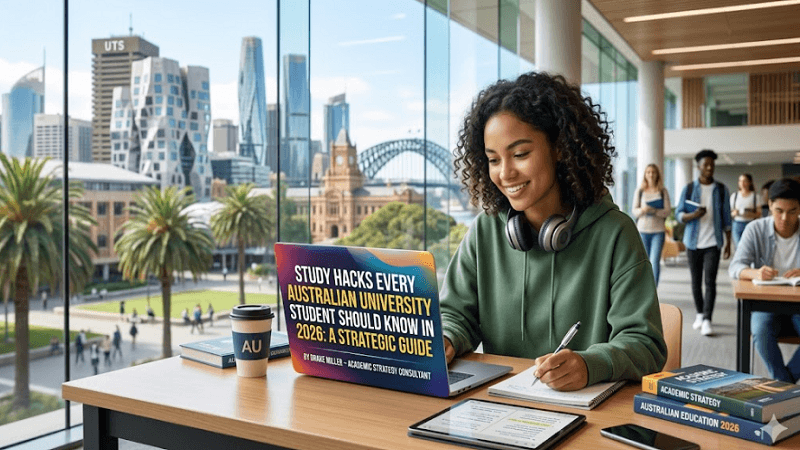
The Australian higher education landscape in 2026 is vastly different from what it was just a few years ago. With the full integration of AI-driven curricula, the rise of “micro-credentials,” and the increasing pressure of the cost of living in major hubs like Sydney, Melbourne, and Brisbane, being a “smart” student isn’t just about long hours in the library—it’s about strategic efficiency.
Whether you are a Year 12 leaver tackling your first semester or a postgraduate student balancing research and a career, these study hacks are designed to help you navigate the unique challenges of the Australian academic system while achieving that elusive High Distinction.
1. Mastering the “Blended” Reality: AI as a Tutor, Not a Ghostwriter
By 2026, most Australian universities—from Group of Eight (Go8) institutions like UWA and Monash to regional innovative hubs—have established sophisticated policies on Generative AI. The Tertiary Education Quality and Standards Agency (TEQSA) has shifted the focus from banning AI to ensuring “AI Literacy.”
The Hack: One of the smartest ways to study more efficiently today is by using AI tools to break down complex theories into simpler, more digestible explanations—think “Explain Like I’m an Undergrad.” Instead of getting stuck in a dense 40-page Macroeconomics PDF, you can extract the key ideas and let AI turn them into concise summaries aligned with your unit’s Learning Outcomes (LOs), or even generate mock quizzes for quick revision. This approach significantly reduces passive reading time, which is often the biggest productivity drain for Australian students. For those making the transition from high school to university, Myassignmenthelp can also provide structured academic support, helping bridge the gap between broad foundational knowledge and the more specialized, in-depth understanding required at the tertiary level.
2. The “Early Bird” HECS-HELP and Census Date Strategy
In 2026, financial literacy is an academic requirement. With indexation rates on HECS-HELP debts being a frequent topic of national debate, managing your “Admin” is now as vital as managing your “Assignments.”
The Hack: Mark a clear “Red Alert” in your digital calendar three days before the Census Date—it’s a critical checkpoint in your semester. This deadline is your last opportunity to withdraw from a unit without facing financial penalties or an academic failure, so it deserves your full attention. Think of this moment as a practical “vibe check” on your workload. Are you keeping up, or starting to feel stretched too thin?
If certain subjects—especially technical or numbers-heavy ones—are beginning to feel overwhelming, it’s worth addressing early rather than waiting until the pressure builds. Seeking structured support, such as managerial accounting assignment help can make a real difference in regaining control and confidence. Taking action at this stage can help you stay on track, avoid unnecessary withdrawals, and finish the semester strong.
3. Reverse-Engineer Your Rubric (The “HD” Checklist)
A common pitfall for Year 12 leavers entering the Go8 system is writing what they think is interesting, rather than what is being assessed. In 2026, marking is increasingly standardized and data-driven.
The Hack: Before you draft a single sentence, copy the “High Distinction” (HD) column of your marking rubric into a fresh document. Treat your assignment like a Compliance Document. If the rubric demands a “Critical analysis of Australian Case Law,” ensure that exact phrase—or a direct variation—is reflected in your subheadings. For students aiming for a high ATAR equivalent in their first year, this “gaming” of the marks ensures you stop wasting word counts on “fluff” and start delivering exactly what the tutor requires for top-tier grades.
4. Master the “Referencing Robot” from Day One
Referencing remains the most tedious way to lose marks in Australian universities, whether you are grappling with APA 7th, Harvard, or AGLC4.
The Hack: Never do a reference manually. Use a Citation Manager like Zotero or EndNote from your very first week. Most Australian university libraries offer free workshops on these tools—attend them. If the technicalities of referencing (especially for complex legal, medical, or engineering papers) become a barrier to your creative flow, utilizing professional referencing and assignment help can ensure your bibliography is flawless and compliant with the latest university-specific style guides, preventing unnecessary “Academic Integrity” flags.
5. Active Recall via “The Feynman Sandbox” (The Pub Test)
In an era where AI can generate facts instantly, rote memorization is officially dead. In 2026, conceptual understanding and the ability to synthesize information are the only things that rank well in exams.
The Hack: Explain a concept without using any technical jargon. In the Australian context, we call this the “Pub Test.” If you cannot explain your thesis or a scientific principle to a mate during a Sunday session, you don’t truly understand it. If you’re a Nursing student studying the Endocrine System, explain it as if you’re talking to a 10-year-old. When you hit a “blank,” that is exactly where you need to refocus your revision. This is particularly effective for high school students moving into complex STEM subjects where the “language” of the subject changes overnight.
6. Leverage the “Pomodoro 2.0” with Aussie Nature
The University of Melbourne’s recent research into “Green Micro-breaks” has gone mainstream in 2026. Living in a country with some of the highest UV levels and most beautiful campus flora, students often forget that the environment is a cognitive tool.
The Hack: Abandon the traditional 25/5 Pomodoro rule. Instead, adopt the 50/10 Outdoor Interval. Study with deep focus for 50 minutes, then spend 10 minutes completely away from screens, preferably outside. Whether it’s a stroll through the Sydney Royal Botanic Gardens or a quiet moment on a campus balcony in Brisbane, the Australian sun helps reset your circadian rhythm, which is often disrupted by late-night study sessions.
7. The “Quiet Floor” Digital Twin
By 2026, campus libraries have evolved into high-energy, collaborative “Innovation Hubs.” While great for networking, they are often terrible for focused writing.
The Hack: Utilize “Digital Body Doubling.” If the quiet floors at the State Library are packed, use platforms like Focusmate or specialized “Study with Me” livestreams. This creates a psychological “Study Zone” through external accountability. Also, check local council libraries; many Australian councils have invested in high-tech “Work Hubs” that offer faster Wi-Fi and fewer distractions during the mid-semester peak—a perfect hack for students living in high-density suburbs like Surry Hills or Southbank.
8. Collaborative “Cloud” Sprints for Group Work
Group assignments remain a polarizing part of Australian academia, yet they are the best preparation for the 2026 “skills-based” hiring market.
The Hack: Eliminate the “deadlocked” group meeting. Instead, initiate “Live Sprints.” Use a shared Google Doc or MS Teams environment and schedule one hour where everyone logs in simultaneously to write live. Seeing cursors moving in real-time creates a “social pressure” that prevents “Social Loafing”—the phenomenon where one or two students do all the work. This method ensures that even the busiest students balancing part-time retail or hospitality work can contribute effectively.
9. The “Post-Lecture” 5-Minute Rule
The “Forgetting Curve” is a brutal reality. In 2026, with the sheer volume of digital content students consume, our brains are trained to discard information quickly.
The Hack: The moment a lecture ends—or you finish a recorded session—do not close your laptop. Spend exactly 5 minutes writing down the three “Big Ideas” from that session. This brief act of “Metacognition” signals to your brain that this information is valuable, moving it from short-term “echo” memory into long-term storage. For high school students, this is the single best way to prepare for the end-of-year exam period without needing to re-learn the entire syllabus in October.
10. Wellbeing: The “Anti-Burnout” Schedule
In 2026, the “Hustle Culture” of the early 2020s was replaced by a focus on “Sustainable Success.” Mental health is now recognized as a core pillar of academic performance.
The Hack: Implement “Reverse Scheduling.” Open your calendar and block out your social life, gym sessions, sleep, and part-time work shifts first. Then, fit your study blocks into the remaining gaps. When study is “scheduled” and finite, you become significantly more efficient because you know you have a hard stop for football practice or dinner with friends. This prevents the “procrastination-guilt” cycle that often leads to burnout.
Frequently Asked Questions
Q.1 How can I balance a part-time job with a full-time study load in 2026?
The key is “Micro-Scheduling.” In the current Australian economy, use the “Reverse Scheduling” method mentioned in Hack #10. Treat your study blocks like a shift at work—non-negotiable and timed.
Q.2 Does my ATAR still matter once I’m at University?
No. Once you have received your offer and enrolled, your ATAR is a historical data point. In 2026, employers focus on your GPA, your “soft skills,” and your digital literacy. However, the study habits you formed during the HSC or VCE remain your most valuable asset.
Q.3 Is using AI for research considered “Academic Misconduct”?
This depends on your specific University’s policy and TEQSA guidelines. In 2026, most institutions encourage using AI for brainstorming and comprehension, but strictly prohibit using it to generate final submissions or code.
About the Author: Drake Miller
Drake Miller is an experienced senior content manager and academic strategy consultant with more than 12 years of expertise spanning higher education and digital marketing. Working across global hubs like Sydney, he focuses on crafting high-impact content strategies and seamlessly integrating AI-driven tools into modern academic systems. His work bridges the gap between content performance and educational innovation, helping institutions and students adapt to an increasingly digital learning environment.