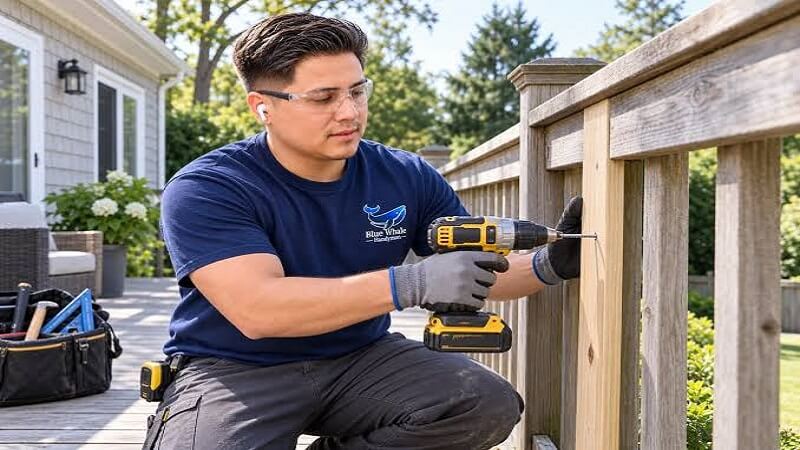
A handyman service provides repair and improvement solutions for commercial and residential properties. Since home maintenance tasks may pile up, busy professionals rely on handymen to handle multiple odd jobs. Here is how handyman services address railing repair and installation:
Newel Post Anchoring
The newel post fastening technique helps secure the load-bearing pillars at the ends of a staircase railing. Because these vertical columns anchor the entire framework, instability in a newel post can compromise the integrity of the handrail. Handymen evaluate the post’s base to determine whether the looseness stems from compromised subflooring or rotted wood.
When dealing with an unstable structure, professionals install the anchoring components. If the back of the staircase is accessible from an unfinished basement, handymen clamp the post to the floor joists. When under-floor access is blocked, specialists rely on modern fastening kits.
Through newel post fastening, handyman services can execute restorations and new railing installations. If an exterior deck becomes loose over time, rebuilding the post attachment with screws restores the system. When installing a new balustrade, experts begin by anchoring the starter newel post.
Handrail Bracket Fastening
Handymen securely anchor a banister to adjacent wall studs so that the rail can support a person’s full body weight. They inspect a wobbly handrail for loose connections and replace corroded or stripped screws with structural fasteners. These additional techniques may be used during the process:
- Countersinking hardware base plates
- Applying rust-resistant coating
- Testing weight-bearing load capacity
Loose Balustrade Securing
Experts restore the structural stability of the vertical spindles that sit between a staircase handrail and the floor. They examine loose connections to determine the cause. To address vulnerabilities in wood assemblies, professionals utilize mechanical fasteners and adhesives to re-anchor the components.
If a wooden spindle has twisted out of its pre-drilled pocket, the handyman extracts and cleans out the piece. They then inject polyurethane wood glue into the subfloor mortise. For older staircases with a detached top connection, specialists drive wood screws at an angle into the rail.
Handymen also work with metal or cable configurations. Wrought iron balusters become loose when their decorative base shoes slide out of place. Professionals re-tighten the internal set screws or apply epoxy inside the floor collars to lock them down. If a cable railing system starts to sag, experts utilize tensioning wrenches to tighten the steel strands.
Since metal components expand and contract differently than wood framing, specialists utilize material-specific fasteners to prevent future loosening. This also protects the hardware from premature wear. Professionals also employ balustrade-securing techniques when installing new railing systems.
Composite System Assembly
Composite system assembly involves piecing together pre-engineered railing components. During assembly, handymen follow specific guidelines since the handrail materials expand and contract with temperature changes. While the components look like wood, they require specialized structural supports to be installed correctly.
When addressing a damaged outdoor railing, handymen either replace the broken parts or reinforce deck borders. If a railing has rotted beyond repair, experts install a new composite system. The assembly requires precision since the components rely on hidden fastening clips.
Explore Handyman Services
Professionals maintain railing systems to restore safety within a home. By addressing structural vulnerabilities early, experts help prevent failures. They can also analyze your stairs and choose the right railing. Contact a handyman to learn more about their offerings.